
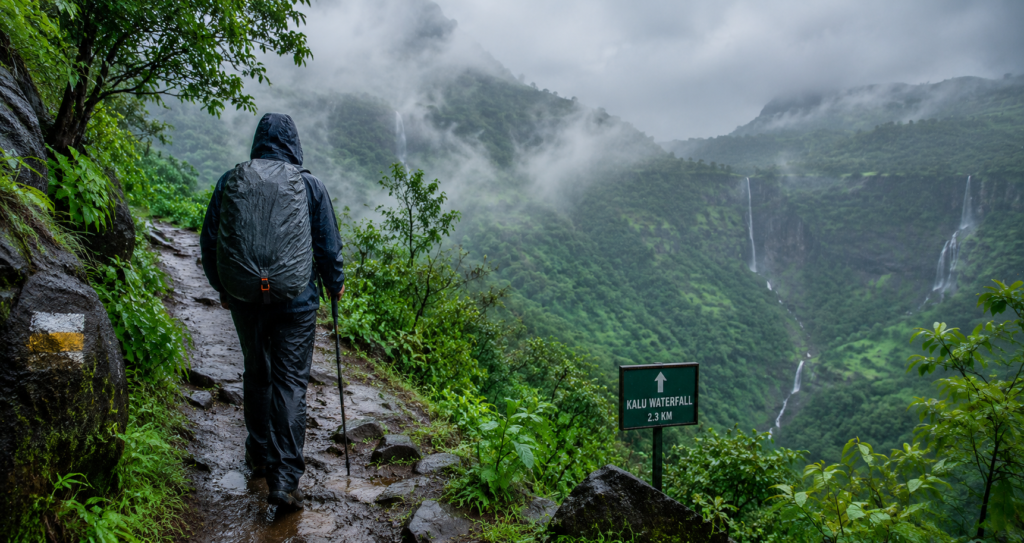
Ask any experienced trekker in India what their favourite season is and a significant number will say monsoon — without hesitation. Not in spite of the rain but because of it. The Western Ghats draped in fifty shades of green that don’t exist at any other time of year. The Sahyadris with waterfalls appearing on hillsides that were bone-dry in April. Trails in Coorg, Chikmagalur, Munnar, and Lonavala that transform completely between June and September into something that feels genuinely wild and alive.
Monsoon trekking in India has grown significantly as a weekend activity over the last decade, particularly among young professionals in cities like Bengaluru, Mumbai, Pune, and Hyderabad who want a break from air-conditioned offices and are willing to drive two or three hours to find it. And for good reason — the accessibility of Indian monsoon treks, many of which are single-day or weekend efforts requiring no technical climbing experience, makes this one of the most achievable forms of outdoor adventure for complete beginners.
But here is where many first-time monsoon trekkers run into trouble: they treat it like a regular hike with a raincoat thrown on top. They show up with cotton clothes, regular sneakers, a school backpack, and one umbrella between four people. The trail quickly teaches them what they should have brought.
This guide is the thing you read before that happens. A complete beginner’s gear breakdown for monsoon trekking in India — what you genuinely need, why you need it, and what you can skip for now.
Why Monsoon Trekking in India Requires Different Gear Than Regular Hiking
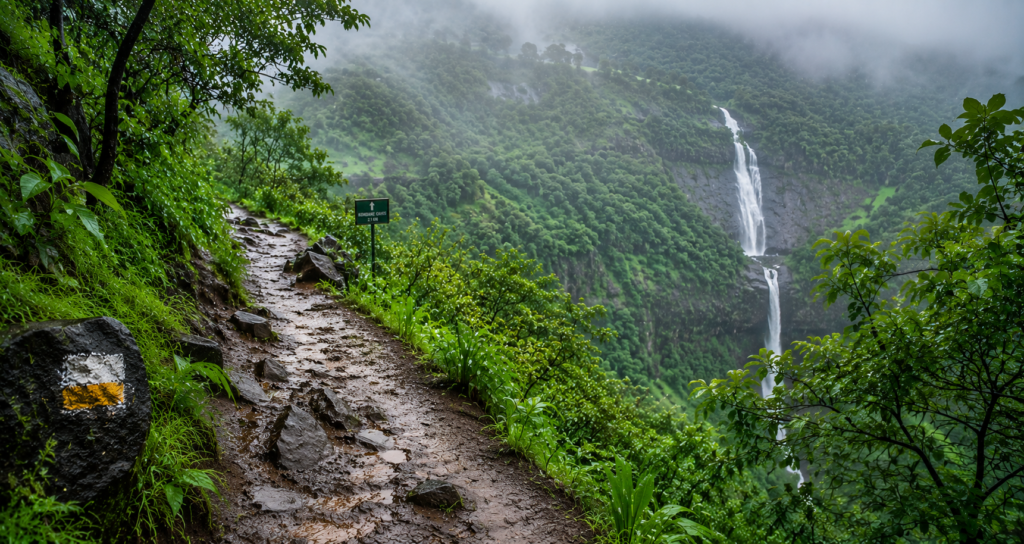
Monsoon trekking presents a specific set of physical challenges that don’t exist on the same trails in October or February. Understanding these challenges is the foundation for understanding why the gear matters.
The trail surface changes entirely. A path that’s firm and manageable in winter becomes a different entity in monsoon. Red laterite soil — common throughout the Western Ghats — turns into a slick, clay-like surface that behaves like wet soap under regular shoes. Rocky sections become slippery with algae and moisture. Stream crossings that are simple steps in dry weather become fast-flowing water bodies that need careful navigation.
Visibility drops. Mist, low cloud cover, and rain reduce visibility on exposed ridges and open hillsides. Trails that are obvious in clear weather can become disorienting in dense monsoon fog. This isn’t typically dangerous on well-marked beginner trails, but it does mean that staying on the path requires more attention.
Everything gets wet — and stays wet. This sounds obvious but its implications for gear are significant. In monsoon conditions, there is no drying out mid-trek. Wet clothes stay wet. Wet bags stay wet. Wet shoes stay wet for the entire duration of the trek and the drive home. Gear that can’t function wet — or that becomes dangerous when wet — is not appropriate for monsoon trekking.
Leeches are real. On forest trails across the Western Ghats, Coorg, and parts of the Northeast during monsoon, leeches are a consistent presence. They’re not dangerous in any serious medical sense, but they are unpleasant and they require specific gear responses — covered footwear, tucked clothing, and knowing what to do when you find one.
With these realities in mind, here’s what goes in your kit.
Gear Item 1: Rain Protection — The Most Important Decision You’ll Make
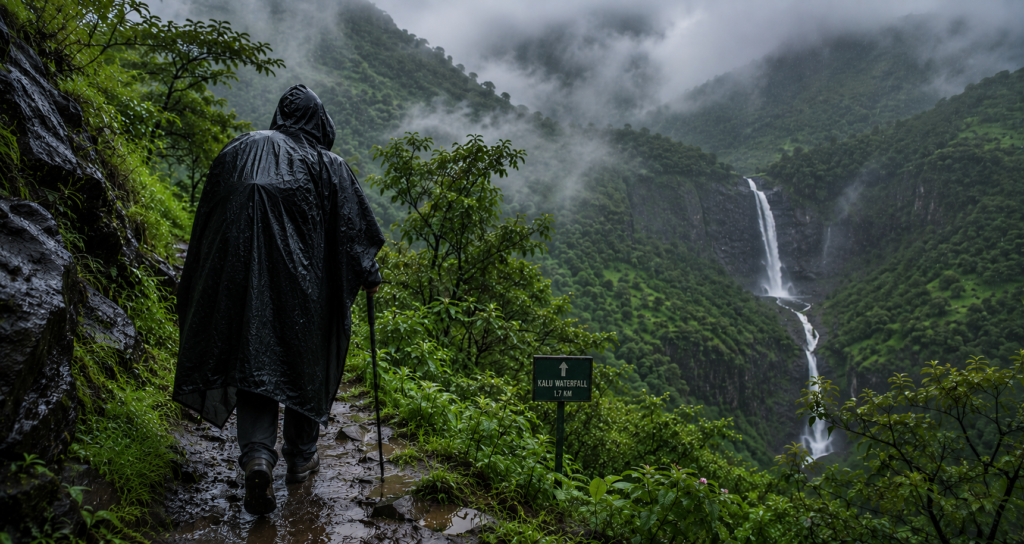
Your rain protection is the single most critical piece of gear for a monsoon trek and it deserves more thought than most beginners give it.
There are two main options: a rain jacket and a rain poncho. They solve the same problem — keeping you dry — but they do so differently, and each has a different set of trade-offs on a monsoon trail.
Rain jackets fit close to the body, give you full arm mobility, have pockets and zip closures, and work well in windy conditions because they don’t catch air. The limitation is that they cover only your upper body — your legs, your backpack, and anything below the waist gets wet unless you also carry rain trousers. For a trail with significant up-and-down movement and changing weather, a well-fitted rain jacket is excellent.
Rain ponchos drape over both your body and your backpack in one piece — no separate pack cover needed. They’re quicker to put on and take off than a jacket, provide better ventilation in warm monsoon conditions because the loose fit allows air to circulate, and they cover your legs down to approximately mid-thigh. The trade-off is reduced arm mobility, which can be awkward when using trekking poles, and they can catch wind on exposed ridges.
For Indian monsoon trekking specifically — where rainfall is often sudden and heavy, where temperatures are warm enough that ventilation matters, and where you’re carrying a backpack that needs protection — a good rain poncho is the more practical choice for beginners. The ability to throw it on in thirty seconds when the sky opens, and to have it cover both you and your pack simultaneously, outweighs the arm mobility limitation on most beginner-level trails.
The Homepixi waterproof rain poncho is designed for exactly this kind of use — lightweight enough to compress into your pack until needed, with hood coverage and sufficient length to protect your legs in heavy rain. It folds down small, which means it adds minimal weight and bulk to your kit until the moment you need it — and on monsoon trails, you will need it.
Gear Item 2: Footwear — Where Most Beginners Go Wrong
This is where the largest number of monsoon trekking mistakes happen, and where the most significant safety issues arise. Footwear on a monsoon trail is not a style decision — it is a safety decision.
Regular sneakers are dangerous on monsoon trails. The rubber soles on standard sneakers are not designed for wet laterite or algae-covered rock. They hydroplane on wet surfaces with very little warning. They also absorb water and become heavy, creating additional strain on your legs and increasing the risk of twisted ankles on uneven ground.
For monsoon trekking, you need footwear with two non-negotiable characteristics: grip and ankle support.
Grip means a deep-lugged sole — the kind you see on proper hiking shoes and trail runners — that bites into mud and wet rock rather than sliding over it. The depth and pattern of the lug matters. Flat-soled shoes and shallow-pattern soles provide almost no grip on wet laterite.
Ankle support means either a mid-cut or high-cut shoe that holds your ankle during the side-to-side movements that wet, uneven trails demand. Low-cut shoes and sandals leave your ankle unsupported on slippery descents — exactly when you most need that support.
The question of waterproofing in footwear is more nuanced than it seems. Waterproof shoes keep water out under light rain and brief puddles — but on a monsoon trek where you’re crossing streams and walking through ankle-deep mud, water will eventually get in regardless. When it does, waterproofed shoes take longer to drain and dry than non-waterproofed mesh hiking shoes. Many experienced monsoon trekkers in India actually prefer quick-drying mesh trail runners over waterproof boots for this reason — the shoes get wet, but they drain fast and dry relatively quickly overnight.
For your first monsoon trek, mid-cut hiking shoes or trail running shoes with deep lugs are the right choice. Avoid sandals, flip-flops, or regular sports shoes entirely.
Gear Item 3: The Right Backpack and How to Pack It
For a beginner’s single-day or weekend monsoon trek, a 20 to 30-litre daypack is the right size. Large enough to carry everything you need, small enough to stay manageable on the trail. Going larger than 30 litres for a day trek adds unnecessary weight and bulk that will make the wet, slippery sections significantly harder.
The backpack needs rain protection. There are two approaches:
A pack with an integrated rain cover — many trekking daypacks come with a built-in rain cover tucked into a pocket at the base of the bag. This is convenient because the cover is always with the bag and can be deployed in seconds.
A separate rain cover — if your pack doesn’t have an integrated cover, a separately purchased pack rain cover sized to your bag works equally well. These are available inexpensively and are worth carrying regardless, since even “water-resistant” packs leak in sustained heavy rain.
If you’re using a rain poncho that covers both you and your pack — which is the case with the Homepixi poncho — your pack has additional protection from above. In heavy, sustained rain, combining a poncho with a pack cover gives your gear the best possible protection.
What goes inside the pack for a monsoon trek:
Pack everything that must stay dry in dry bags or ziplock bags inside your main pack. This includes your phone, any extra clothing, snacks, and first aid items. Dry bags are inexpensive and compress flat when not in use — every monsoon trekker should have two or three in different sizes. In monsoon conditions, treat every item in your pack as if it will get wet unless actively protected.
Gear Item 4: Clothing — What to Wear and What to Leave Behind
The clothing rule for monsoon trekking is simple and absolute: no cotton.
Cotton is comfortable, affordable, and familiar — and it is the wrong fabric for a monsoon trail for one critical reason. Cotton absorbs water and holds it. A wet cotton t-shirt stays wet for hours. In warm monsoon conditions, this creates chafing and discomfort. In higher altitude treks where temperatures drop after rain, wet cotton against the skin can cause rapid body temperature loss — a genuinely dangerous situation on exposed ridges.
Synthetic fabrics — polyester and nylon blends — are the right choice. These fabrics wick moisture away from the skin rather than absorbing it, and they dry significantly faster than cotton when wet. A synthetic t-shirt worn during a river crossing and then a thirty-minute uphill section will be nearly dry by the time you reach the top. A cotton shirt will still be soaking.
What to wear:
A synthetic moisture-wicking t-shirt or full-sleeved top is the base layer. Full sleeves have the added benefit of providing some protection against leech attachment on forested trails — a practical reason to consider a long-sleeved synthetic top over a short-sleeved one.
Trekking trousers or quick-dry shorts depending on the terrain and your comfort. For forested trails where leeches are likely, full-length trekking trousers tucked into your socks at the ankle significantly reduce leech contact. For more open terrain with less forest cover, shorts with leech socks are a common alternative.
Carry one complete set of dry clothes in your pack — sealed in a dry bag — that you change into at the end of the trek. This is not optional. Driving home in wet trekking clothes is deeply uncomfortable, and in air-conditioned vehicles it can lead to chills that ruin the next two days.
Gear Item 5: Trekking Poles — More Useful Than Beginners Expect
Many beginner trekkers view trekking poles as something experienced hikers use on serious mountain expeditions — not something a first-timer needs for a weekend trail in the Sahyadris. This is a misconception that the first slippery monsoon descent will correct quickly.
On a wet trail, trekking poles do two things that matter enormously for safety. First, they give you two additional points of contact with the ground — converting your bipedal balance into a more stable four-point system on sections where your feet alone may not provide reliable grip. Second, they allow you to test the ground ahead before committing your full weight to it — critical on monsoon trails where loose rock and mud beneath the surface can give way without warning.
On steep, slippery descents — which are consistently the most treacherous sections of any monsoon trek — trekking poles are the difference between a controlled, confident descent and a nervous, exhausting crawl where you’re sitting down every few metres because you don’t trust your footing.
For beginners, a basic pair of adjustable aluminium trekking poles is sufficient. Set them slightly shorter than elbow height for uphill sections and lengthen them slightly for descents — this adjustment takes five seconds and makes a significant difference in how much work your arms do.
The one consideration when using poles with a poncho is arm mobility — ponchos restrict arm range slightly, which can make pole planting less fluid. Practising the combination before your trek, even just in the parking area, helps you find a comfortable rhythm.
Gear Item 6: The Safety Essentials — Small Items That Matter a Lot
These are the small items that experienced trekkers carry automatically and that beginners consistently forget. Each one is lightweight, inexpensive, and has a specific function on a monsoon trail.
Salt or a lighter for leeches. On forested monsoon trails, leeches are almost inevitable. They’re harmless — they don’t transmit disease in Indian conditions — but they require calm management. Do not pull them off forcefully; this can leave the mouthpart in the skin and cause infection. A small amount of salt or the brief application of a lighter flame encourages them to release on their own. A small salt packet from a restaurant works fine.
A headlamp or torch with spare batteries. Monsoon cloud cover and the density of forest on many Indian trails reduces light levels significantly, and treks that start late or run longer than planned can put you on the trail after dark. A headlamp keeps both hands free, which matters when navigating slippery terrain. Keep batteries in a dry bag.
Waterproof first aid basics. A small first aid kit — antiseptic wipes, bandages, blister plasters, and a pain reliever — sealed in a ziplock bag. Falls on wet trails produce scrapes and cuts that need prompt basic care.
Energy snacks in waterproof packaging. Glucose biscuits, dry fruits, nuts, energy bars — foods that provide quick fuel and don’t turn to paste when wet. Monsoon trekking burns more energy than the same trail in dry conditions because of the additional effort required to maintain balance and footing on slippery surfaces.
A fully charged power bank in a dry bag. Emergency communications depend on your phone working. Humidity and rain accelerate battery drain in smartphones.
Electrolyte sachets. You sweat heavily on warm, humid monsoon trails even though the rain masks it. Electrolyte sachets dissolved in water prevent the fatigue and muscle cramps that dehydration causes on longer treks.
Choosing Your First Monsoon Trek: Where to Start in India
With your gear sorted, the next question is where to go. India has an extraordinary range of beginner-friendly monsoon treks within a few hours of every major city.
From Bengaluru: Kodachadri, Kumara Parvatha (for slightly more experienced beginners), Nandi Hills, Antharagange, and the trails around Coorg and Chikmagalur. The Shola forests of the Nilgiris are particularly spectacular in monsoon.
From Mumbai and Pune: The Sahyadris offer dozens of accessible monsoon treks — Rajmachi, Harishchandragad (more challenging), Lohagad, Visapur, and the trails around Lonavala and Khandala. The combination of fort ruins and monsoon landscape makes these particularly atmospheric.
From Hyderabad: The Araku Valley trails in Andhra Pradesh and the Nallamala Forest treks are within driving distance and offer proper monsoon forest experience.
From Delhi and North India: The Himachal Pradesh trails shift character in monsoon — some close due to landslide risk, but trails like Kheerganga and the meadows around Manali remain accessible and extraordinarily beautiful.
For your first monsoon trek, choose a trail that is well-documented, popular, and single-day. Avoid trails with significant river crossings, known landslide exposure, or inadequate marking. Go with a group, ideally with someone who has done the specific trail before.
Before You Go — A Beginner Monsoon Trek Checklist
Run through this before you leave:
Rain protection: Poncho or rain jacket packed and accessible at the top of your bag — not buried at the bottom where you can’t reach it when the rain starts suddenly.
Footwear: Hiking shoes or trail runners with deep-lug soles. No sneakers, no sandals.
Clothing: Synthetic base layers. Full dry set sealed in a dry bag. No cotton.
Pack protection: Rain cover on your bag and/or poncho covering it.
Dry bags: Phone, ID, emergency cash, extra clothing, and first aid kit all sealed independently.
Safety kit: Salt or lighter for leeches, headlamp, basic first aid, energy snacks, power bank, electrolytes.
Poles: If you have them, bring them. If not, a sturdy stick found on the trail works for basic balance assistance.
Information: Download the offline map of your trail before you leave. Signal on monsoon trails in forested areas is unreliable.
Tell someone your plan. Share your trail name, expected return time, and car details with someone not on the trek. This costs nothing and matters if something goes wrong.
FAQ
Yes, on appropriate beginner trails — short, well-marked, popular routes that are regularly completed by people of average fitness with no prior trekking experience. The key is choosing the right trail for your level and going prepared with the right gear. Avoid trails with known technical sections, river crossings, or landslide exposure as a first-timer.
For Indian monsoon conditions and beginner trekkers, a rain poncho has practical advantages: it covers both you and your backpack simultaneously, deploys in seconds, and provides better ventilation in warm, humid trail conditions. Rain jackets offer better arm mobility and work better in wind, making them preferable for more technical trails or exposed ridgelines
Stay calm — leeches in Indian monsoon conditions are harmless. Carry a small amount of salt to encourage them to detach without forceful pulling. After each section of forest trail, check your ankles and lower legs. Tucking your trekking trouser hems into your socks reduces contact significantly.
This is strongly inadvisable. Regular sports shoes have flat or shallow-pattern soles that provide very little grip on wet laterite soil or algae-covered rock — the most common trail surfaces on Indian monsoon treks. Proper hiking shoes or trail runners with deep lugs are a safety requirement, not a preference.
The most important item on this list is your rain protection — and it needs to work the moment you need it, not five minutes later. The Homepixi waterproof rain poncho is lightweight, quick to deploy, and covers both you and your pack — everything a beginner monsoon trekker needs from their rain gear. Shop here →