
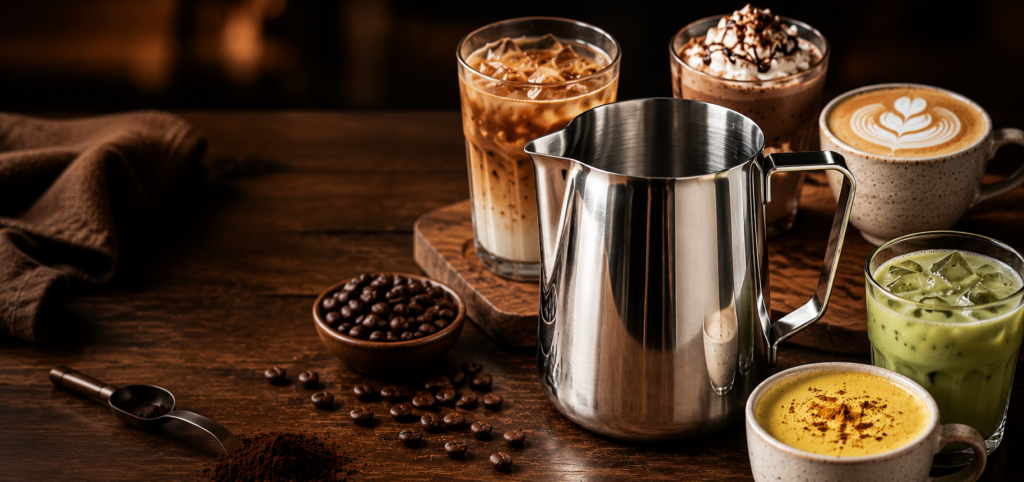
Milk frothing pitcher — that’s often the missing piece behind that specific kind of disappointment that comes with spending ₹400 on a café latte, taking one sip, and thinking: I could make this at home. And the frustrating part is, you probably could. The gap between café coffee and home coffee isn’t really about the beans or the machine. More often than not, it comes down to one thing: the milk — and whether you’re using the right milk frothing pitcher to work with it.
Properly frothed milk changes the texture of a drink entirely. It adds body, it carries flavour differently, and it turns something you’d gulp down in three minutes into something you actually sit with. A milk frothing pitcher is what makes that possible at home — and it does a lot more than just lattes.
If you’ve got one sitting on your counter (or you’re thinking about getting one), here’s a proper guide to everything you can make with it — hot, cold, and a few things you probably haven’t considered yet.
First: What a Frothing Pitcher Actually Does
Before getting into the drinks, a quick word on why the pitcher itself matters — not just the frothing wand or machine.
A well-designed frothing pitcher, typically stainless steel, does two things that a regular cup or mug can’t. One, it distributes heat evenly as you steam or froth, so the milk heats consistently rather than scalding at the base while staying cold at the top. Two, the shape — the tapered spout and the curved body — gives you control over how you pour. That control is what makes latte art possible, and it’s also what makes a clean, layered cold drink achievable without everything immediately mixing together.
The Homepixi frothing pitcher is stainless steel with a pour spout designed for both precision pouring and comfortable frothing. It works with handheld electric frothers, steam wands, and manual whisks — so you don’t need a full espresso machine to use it well.
Hot Drinks
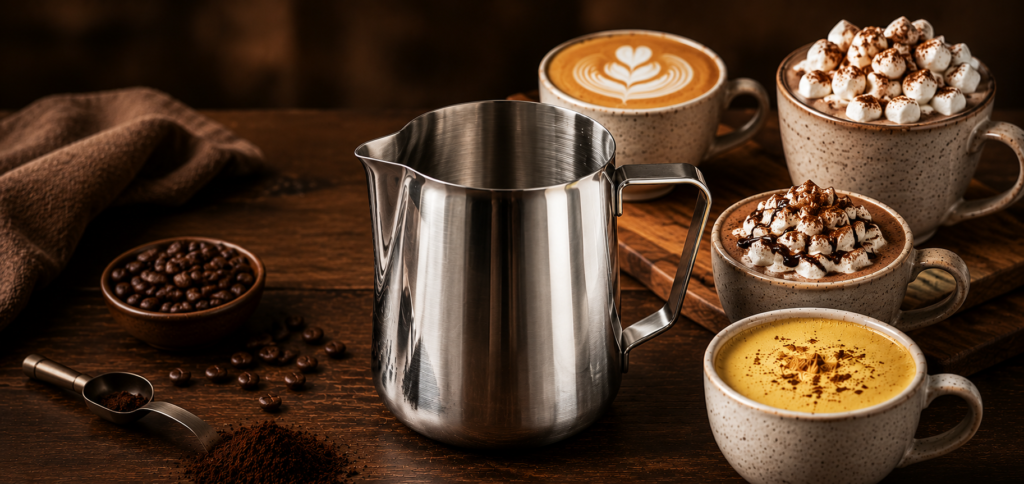
Café Latte
This is the obvious starting point, but it’s worth doing properly.
A latte is espresso and steamed milk, with a thin layer of microfoam on top. The milk-to-coffee ratio is generous — roughly 3:1 in favour of milk — which is why the quality of the milk matters so much. Bad frothing gives you either flat, watery milk or a huge pile of dry foam that sits on top and contributes nothing.
What you’re aiming for is microfoam: milk that’s been aerated just enough to feel velvety, with tiny uniform bubbles throughout rather than a separate frothy cap. The temperature should sit around 60–65°C — hot enough to feel warm in your hand through the cup, but not scalding.
To make it at home: brew a strong espresso or two shots of moka pot coffee. Froth your milk in the pitcher until it’s silky and has roughly doubled in volume. Pour the milk from a slight height to integrate it, then lower the pitcher close to the cup surface to layer the foam. It takes a few tries. When it works, it’s genuinely satisfying.
Milk tip: Whole milk froths best for a latte. Full-fat gives you the creamiest microfoam. If you prefer oat milk, it froths reasonably well — barista-grade oat milk even better.
Cappuccino
Same base as a latte, different ratio. A cappuccino is equal parts espresso, steamed milk, and foam — which means the foam here is a feature, not a garnish.
The pitcher helps you control this split. Froth your milk until it’s airy and has clearly separated into liquid milk below and thick foam above. When you pour, tilt the cup and pour slowly — the liquid milk pours first, and you spoon the thick foam on top to finish.
A good cappuccino should be small (around 150–180ml), strong, and almost dry on top. If it feels too milky, you’ve used too much steamed milk relative to foam.
Masala Chai Latte
This one doesn’t get enough credit as a frothing pitcher drink, possibly because masala chai is so deeply ingrained as a stovetop ritual in Indian homes that the idea of frothing it feels unnecessary. But a chai latte — proper chai brewed strong and paired with frothed milk — hits differently when the milk has texture.
Brew your chai concentrate the way you normally would: water, tea, ginger, cardamom, a little black pepper, perhaps some cinnamon — but use half the amount of water you usually would, so it’s intensely flavoured. Pour that into your cup. Then froth full-fat milk in your pitcher until it’s creamy and smooth, and pour it over the chai concentrate.
The spices come through more clearly against the velvety milk than they do in a regular milky chai. Add a pinch of cinnamon on top and it looks and tastes like something from a specialty café, made entirely from things your kitchen already has.
Hot Chocolate That Actually Tastes Like Hot Chocolate
Most homemade hot chocolate is thin. You stir cocoa powder into warm milk and end up with something closer to chocolate-flavoured milk than a proper drinking chocolate. The difference, again, is in the frothing.
Warm your milk in a saucepan with good quality cocoa powder and a little sugar — whisk it well so there are no lumps. Then transfer to your frothing pitcher and froth until you have a thick, creamy texture throughout. The aeration gives the hot chocolate a body it doesn’t have when simply stirred. If you have dark chocolate, melt a square or two into the milk as it warms. Pour and dust lightly with cocoa or cinnamon.
This is the version of hot chocolate that actually feels indulgent. It’s also a good use of your frothing pitcher on days when you don’t want caffeine.
Turmeric Latte (Haldi Doodh, Upgraded)
Haldi doodh has been an Indian household staple for generations, long before it appeared on café menus with a ₹350 price tag and the label “golden milk.” The base is the same: warm milk with turmeric, black pepper (which helps absorb the curcumin), a little sweetener, and usually some ginger.
What the frothing pitcher adds is texture and warmth retention. Froth the spiced milk until it’s airy and golden, and it transforms from a slightly gritty home remedy into something genuinely pleasant to drink. The black pepper is non-negotiable — it’s not just traditional, it’s functionally important for the turmeric to work properly.
Cold Drinks

Cold Coffee (The Version That Rivals the Café)
India’s relationship with cold coffee is its own thing — thick, sweet, milky, nothing like an iced Americano. And a frothing pitcher, combined with a frother, lets you make the proper version at home.
Brew strong coffee and let it cool completely. Add it to a glass with cold milk and sugar (or sweetened condensed milk for the real café-style flavour). Then froth a small amount of cold milk separately until it’s thick and airy — cold frothing takes a little longer than hot but works well with a handheld electric frother. Spoon the cold foam over the top of your cold coffee.
The result has layers: the sweet coffee-milk at the base, the cold foam floating on top. It looks good and tastes exactly like what you’d pay ₹300 for. The pitcher’s spout gives you the control to add the foam without disturbing the layers below.
Dalgona Coffee (Done Right)
Dalgona had its moment during lockdowns and hasn’t entirely gone away, because it’s genuinely delicious when made properly. Equal parts instant coffee, sugar, and hot water, whipped until it forms a thick, glossy foam. Spooned over cold milk.
The frothing pitcher comes in for the milk component. Cold-frothed full-fat milk underneath a dalgona layer gives the drink a texture you don’t get with flat cold milk. Pour your cold milk into the pitcher, froth until airy, pour into your glass, then carefully spoon the dalgona foam on top without mixing. Drink by swirling it together, or leave it layered and taste both components as they naturally combine.
Iced Matcha Latte
Matcha has found a solid audience in Indian cities over the last few years, partly because of the caffeine-without-the-jitters quality and partly because it looks incredible in a glass. An iced matcha latte is one of the simplest and most visually satisfying drinks you can make at home.
Whisk matcha powder with a small amount of hot water until smooth — no lumps. Add ice to a glass, pour in cold milk, and then slowly add the matcha mixture over the back of a spoon to create the layered green-and-white effect. Froth a little additional cold milk and spoon it over the top if you want that café-style finish.
The frothing pitcher handles the cold milk frothing step cleanly, and its pour spout gives you the precision to layer without disturbing the presentation.
Cold Brew with Frothed Milk
If you’ve moved to making cold brew at home — coffee grounds steeped in cold water for 12–18 hours — the natural pairing is cold-frothed milk. Cold brew on its own is smooth and low-acid. Adding flat milk to it is fine. Adding cold-frothed milk makes it genuinely special.
Froth cold full-fat milk in your pitcher, pour over ice, add your cold brew concentrate over the top (it’ll create a nice gradient), and leave it layered. The foam holds its shape surprisingly well on cold drinks if the milk is cold enough going in.
A Note on Milk Temperature and Technique
One thing that takes these drinks from decent to genuinely good: temperature control. For hot drinks, milk frothed between 60–65°C is the sweet spot. Below that, it feels lukewarm. Above 70°C, the milk proteins start to break down, the sweetness reduces, and the foam becomes unstable.
For cold drinks, start with milk straight from the fridge. The colder the milk going in, the better the cold foam holds. A handheld frother works well here — froth in the pitcher, then pour directly from it.
The stainless steel of the Homepixi pitcher helps you gauge temperature by feel — once the pitcher is too hot to hold comfortably for more than a second or two (around 65°C), you’re at the right point for hot drinks. No thermometer needed once you’ve done it a few times.
More Than Just Coffee
The drinks above cover a wide range, but they share one thing: they’re all significantly better with properly frothed, well-handled milk than they are without it. A frothing pitcher isn’t a single-use gadget for lattes. It’s a small tool that improves almost anything milk touches — chai, hot chocolate, haldi doodh, matcha, cold coffee, and more.
If you’re already making any of these drinks at home, the pitcher makes them better. If you haven’t tried some of the options on this list — the chai latte and cold-frothed cold coffee especially — they’re worth an attempt this week.
Also on Homepixi:
- Homepixi Vacuum Sealer Rolls — keep your coffee beans and spices fresh for longer
- Stainless Steel Measuring Cups — for precise recipes and café-style drinks at home
- Magnetic Measuring Spoons — for perfectly measured matcha, cocoa, and spice blends
Absolutely. A frothing pitcher works with any frothing method — a handheld electric frother, a manual whisk, or a steam wand if you have one. You don’t need an espresso machine at all. Most of the drinks in this list, including the chai latte, haldi doodh, cold coffee, and hot chocolate, don’t use espresso in the first place. The pitcher is just a vessel that helps you froth, control temperature, and pour cleanly — the heat source and frothing tool are separate.
Full-fat whole milk gives you the creamiest, most stable foam — it’s the easiest to work with and the most forgiving if your technique isn’t perfect yet. Toned milk (the standard 3% fat variety most Indian homes use) works reasonably well for hot drinks but produces slightly less body. For cold drinks, the colder the milk going in, the better the foam holds. If you prefer plant-based options, barista-grade oat milk is your best bet — it’s specifically formulated to froth well and doesn’t split the way regular oat or almond milk sometimes does under heat.
Rinse it immediately after use — milk proteins stick fast once they dry, and a pitcher left sitting for even 20 minutes is noticeably harder to clean than one rinsed straight away. For daily cleaning, warm water and a drop of dish soap is enough. Once a week, fill it halfway with warm water, add a tiny amount of baking soda, and let it sit for a few minutes before rinsing — this keeps any milk residue or odour from building up inside. Avoid abrasive scrubbers on stainless steel; a soft sponge keeps the surface clean without scratching.
Cold frothing works well — it just takes a little longer than hot frothing. Start with milk straight from the fridge (the colder the better) and froth with a handheld electric frother for about 30–45 seconds longer than you would for hot milk. The foam you get is lighter and airier than hot microfoam, and it holds its shape surprisingly well on cold drinks when the milk temperature is low enough going in. Cold-frothed milk on dalgona coffee, iced matcha lattes, and cold brew is what gives them that layered café look rather than a flat, mixed appearance.