

Magnetic measuring spoons set of 05 fix one of the most common frustrations in Indian home cooking — the “why doesn’t it taste the same” problem. You made biryani last Sunday. It was perfect — fragrant, layered, exactly the kind that makes people go quiet at the dinner table. So you make it again this weekend, same recipe, same pot, and somehow it tastes completely different. Not bad, but not that.
The good news: your cooking skills are probably not the problem at all.
The Real Reason Biryani Masala is So Inconsistent
Biryani is not a single-spice dish. A typical masala for biryani involves anywhere from 10 to 18 different spices — whole and ground — each contributing a distinct note of flavour, aroma, and heat. The final taste is the sum of all of these in a very specific ratio. Change that ratio, even slightly, and the biryani changes with it.
Most home cooks eyeball their spices. A “pinch” of this, a “handful” of that, spices poured straight from the packet into a palm and then into the pot. This works fine for experienced cooks who have made the dish hundreds of times and whose hands have become calibrated over years of repetition. But for anyone who doesn’t cook biryani every week, the margin for error is wide.
Here’s a simple truth: a difference of half a teaspoon of black pepper or cloves can shift your biryani from subtle and aromatic to sharp and overpowering. These are not flavour notes you can easily correct once they’re in the pot.
Mistake #1: You’re Not Measuring — You’re Estimating
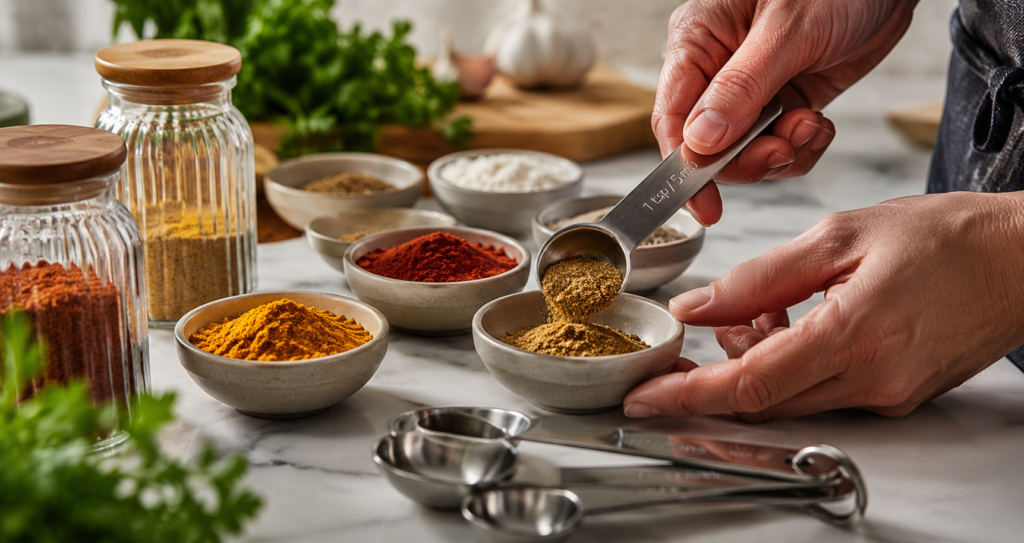
Magnetic measuring spoons set of 05 solve the biggest culprit behind inconsistent biryani: guesswork at the spice stage. Indian cooking culture has always been wonderfully intuitive — generations of home cooks learned by watching, tasting, and adjusting. But that intuition takes time to develop. Until it does, eyeballing spices creates a different biryani every single time, depending on how big your pinch was, how hungry you were, and whether you got distracted between steps.
Professional chefs and test kitchens don’t leave this to chance. Every recipe that needs to be replicated precisely is measured to the gram or millilitre before cooking even begins. The French call this mise en place — everything in its place. Indian grandmothers who cook flawlessly by feel have simply internalised their measurements over decades of practice.
The fix is straightforward: measure every spice before it goes into the pot. Not just the ground ones — the whole spices too. One green cardamom looks very different from another in terms of actual flavour yield, so even whole spices benefit from a count or a measured portion.
Mistake #2: Using Spices Without Knowing Their Strength
Not all cumin is equal. A fresh jar of cumin opened this month will smell sharp and earthy and fill the kitchen as it hits the hot oil. Cumin that’s been sitting in a steel container for eight months smells like cardboard and contributes almost nothing to the dish.
This catches people out constantly. You follow the recipe exactly, use the “right” amount — but your biryani still tastes flat. The spices did their job on paper but not in the pan.
The rule of thumb: whole spices retain potency for about 12 to 18 months. Ground spices start losing strength after six months, and significantly so after a year. If your biryani tastes muted despite using what feels like plenty of masala, check when you bought those spices.
Buy whole spices and grind small batches fresh at home when possible. The difference in aroma is immediate and significant. Store in airtight containers away from light and heat — not above the stove, where steam and heat degrade them fastest.
Mistake #3: Adding Spices in the Wrong Order
The sequence in which you add spices to the pot matters enormously in biryani. Whole spices — bay leaves, cinnamon, cloves, cardamom — go in first with the hot oil or ghee. They need direct heat to bloom and release their essential oils. This step is not optional. Skipping it or rushing it leaves those spices underdeveloped.
Ground spices, on the other hand, go in later, usually after the onions. They go into the mixture and cook briefly before the yoghurt or tomatoes are added, which cools the pan and stops them from burning.
If you add whole spices and ground spices together at the same stage, neither gets what it needs. The whole spices don’t bloom properly, and the ground spices often scorch.
Write the order down. Keep a sequence card near your stove for biryani days. Cooking from memory while managing onions, rice, and marinated meat simultaneously is where most of the order-of-addition mistakes happen.
Mistake #4: Inconsistent Fried Onion Quantity

Birista — the crispy fried onion — is the quiet backbone of most biryani recipes. It provides sweetness, body, and a caramelised depth that you can’t replicate with raw onion. But the amount of birista that ends up in the pot varies wildly depending on how quickly you cook them, how dark you take them, and how many you snack on while they’re draining.
Half a cup of loosely fried onions and half a cup of deeply caramelised, crispy onions are the same volume but entirely different in flavour concentration. The caramelised version is far more intense. If you get your birista darker than last time, your biryani will taste richer and sweeter than expected.
To fix this: fry onions in consistent batches, take them to the same colour point every time (a deep amber, not black), and measure the finished birista before adding it to the masala. It sounds pedantic, but this one step alone can dramatically stabilise your results.
Mistake #5: Not Writing Down What You Did
This sounds obvious, but most home cooks don’t do it. You make a great biryani, everyone loves it, and you store the memory as “I’ll just do the same thing next time.” But cooking memory is unreliable. You forget whether you used three cardamoms or four, whether the marination was two hours or four, whether you added a pinch of nutmeg that day or not.
Keep a simple kitchen notebook or a notes app entry for your biryani. Write down every quantity, every timing, every observation — what you changed, what worked, what didn’t. Treat your recipe like a chef’s formula, not a rough guide. After three or four iterations with notes, you’ll have your own personalised, locked-in recipe that produces the same result every time.
The Tool That Changes Everything: A Good Set of Measuring Spoons
All of the fixes above become dramatically easier when you have a reliable set of measuring spoons within reach. The standard palm-pinch method might feel familiar, but it’s the single most common cause of variation in spice-heavy dishes like biryani.
A quality set of measuring spoons — covering everything from ¼ teaspoon to 1 tablespoon — lets you be exact with every spice, every time. If your recipe calls for ¾ teaspoon of black pepper, you measure ¾ teaspoon of black pepper. Not “about that much.” Not “a small palmful.” Exactly ¾ teaspoon.
Homepixi’s magnetic measuring spoons are designed for exactly this kind of precision cooking. The magnetic closure keeps the full set together in one place so you’re not hunting for the ½ teaspoon in a cluttered drawer right when the oil is ready. They’re stackable, easy to clean, and built for the kind of daily spice work that Indian cooking demands.
For biryani specifically, having a complete set means you can measure out all your spices into small bowls before you light the stove — true mise en place, without the guesswork.
Your Biryani Fix: A Quick Summary
To bring your biryani masala into consistency, here’s what to change starting with your next cook:
Measure every spice before you start. Don’t add directly from the packet. Use measuring spoons and prepare all your spices in advance.
Check your spice freshness. If anything smells flat or dusty, replace it. Fresh spices are the fastest upgrade your biryani can get.
Follow the order of addition. Whole spices bloom first in hot oil. Ground spices go in later, once the onions are ready.
Measure your birista. Take it to the same colour, use the same quantity every time.
Write it all down. After your next successful biryani, document every quantity and timing. That document is worth more than any YouTube tutorial.
Biryani isn’t complicated — it’s precise. Once you respect the precision, the results become remarkably repeatable. And that’s when cooking goes from hit-or-miss to genuinely satisfying.
Ready to cook biryani that tastes the same every time? Start with the right tools. Explore Homepixi’s measuring spoons — built for precision, designed for Indian kitchens.
Most likely because spices are being estimated rather than measured. Small variations in spice quantity compound across 10–15 ingredients and produce noticeably different results. Using measuring spoons for every spice is the most effective fix.
Crush a small amount between your fingers and smell it. Fresh spices should have a sharp, immediate aroma. If the smell is faint or dusty, the spice has lost potency and needs to be replaced.
That depends on the style, but whole spices like cardamom, cloves, and cinnamon form the aromatic base in most biryanis. Getting these right — fresh, correctly bloomed in hot ghee — makes the biggest difference to the overall fragrance of the dish.
Making your own from whole spices gives you control over freshness and ratios. Store-bought masala is convenient but varies significantly between brands and can contain filler ingredients. For consistent results at home, a measured fresh blend is always superior.
A minimum of two hours is recommended for chicken; for mutton, overnight marination produces significantly better results. The yoghurt and spices need time to penetrate the meat rather than just coating the surface.