
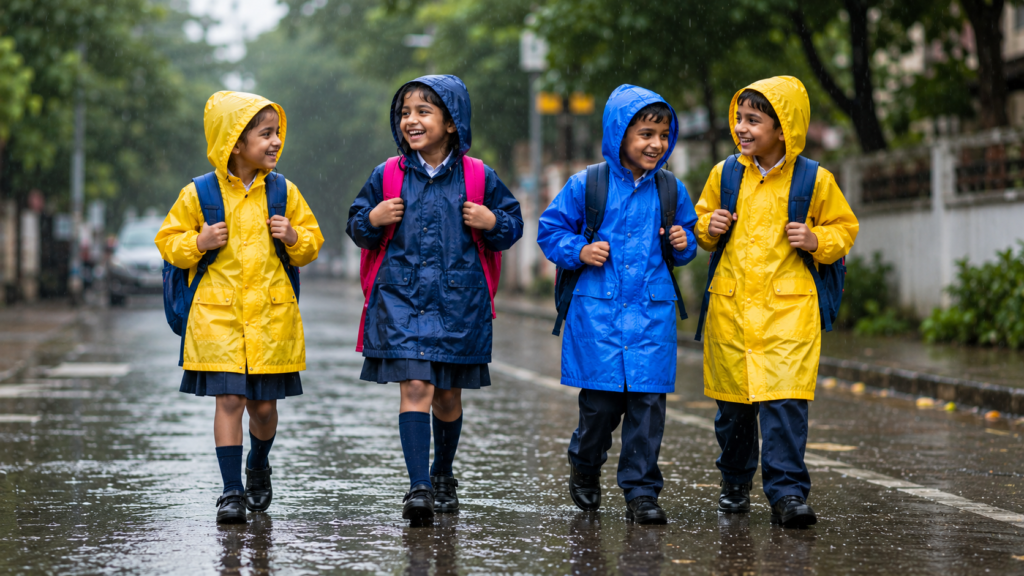
Every June, the same scene plays out across Indian households. The monsoon arrives, the school bag comes out, and somewhere in the back of the cupboard is last year’s raincoat — too small, cracked at the hood seam, or missing a button. So you end up buying another one in a hurry, and the cycle repeats.
Buying the best raincoat for kids in India doesn’t have to be that cycle. When you know what actually matters — material, fit, safety features, and school-day practicality — you can make a choice that lasts the full season and maybe the next one too.
This guide covers everything Indian parents need to know before picking up rainwear for children this monsoon.
Why Most Kids’ Raincoats in India Fail by Mid-Season
Before jumping to what to look for, it helps to understand what goes wrong. The most common complaints parents have about kids’ raincoats are:
- The coat doesn’t fit over the school bag
- It traps heat and the child refuses to wear it after the first day
- The hood doesn’t stay on in wind
- The seams or zippers give way within a few weeks
- The child has grown and it no longer fits properly
Most of these issues come down to one thing: buying on looks or price alone, without checking the features that actually matter for Indian monsoon conditions.
What to Look for When Buying a Raincoat for Kids in India
1. Material: EVA vs PVC vs Polyester
The material is the single most important factor in a kids’ raincoat — more than colour, brand, or price.
PVC (Polyvinyl Chloride) is the most common material you’ll find on budget raincoats. It’s waterproof and affordable, but in India’s humid climate it traps body heat, can feel stiff in cooler weather, and cheaper variants may contain harmful plasticisers. Fine for occasional use, but not ideal for daily school wear.
EVA (Ethylene-Vinyl Acetate) is the better choice for children aged 3–10. It is non-toxic, odourless, soft, and flexible even in cooler monsoon weather. It doesn’t have the stiff “plastic sheet” feel that makes many children resist wearing their raincoat. If you’re shopping for younger kids, prioritise EVA.
Coated Polyester is lightweight and breathable — the material found in quality outdoor rainwear. For older kids (10+) or for cycling and trekking use, a polyester shell with a waterproof coating offers the best balance of protection and comfort.
What to avoid: Any listing that says “water-resistant” without specifying a material or hydrostatic head rating. Water-resistant coatings often fail in 20–30 minutes of sustained rain — not enough for an Indian monsoon commute.
2. School Bag Compatibility
This is the feature most parents overlook and most regret. In India, children walk to auto stands, bus stops, and school gates carrying bags that weigh 3–5 kg. A raincoat that fits perfectly over nothing will be too tight or uncomfortable over a full school bag.
Look for:
- Extended back panel — a wider cut at the rear that can accommodate a school bag underneath
- Integrated bag cover — some designs have a built-in flap that pulls out to cover the bag separately
- Generous shoulder room — the raincoat should not restrict arm movement when the bag is on
If a product listing doesn’t mention school bag fit or show photos with a bag, test this before buying in-store or check return policies when buying online.
3. Fit and Sizing — Always Size by Height, Not Age
Kids’ raincoat sizing in India is notoriously inconsistent. A “Medium” from one brand will not match a “Medium” from another. Age labels are even less reliable.
The right approach: measure your child’s height in centimetres and compare against the brand’s size chart. When in doubt, size up — a slightly larger raincoat is wearable; one that doesn’t close over a bag or school sweater is useless.
Ideal length: The coat should reach mid-thigh or just above the knee. Too short and trouser legs get soaked; too long and walking becomes awkward.
4. Hood Design
A good hood makes a significant difference in how much protection the raincoat actually provides. Key things to check:
- Adjustable drawstring or elastic — keeps the hood in place in wind rather than blowing back off the head
- Transparent brim or stiffened peak — helps protect the face and eyes from rain without blocking vision
- Wide neck coverage — prevents rain from running down the collar
Hoods that are loosely attached or have no adjustment will come off constantly, and the child will end up just leaving them down.
5. Closure Type
The closure — how the raincoat fastens — determines both how waterproof it actually is and how easy it is for a child to use independently.
- Double-zip with flap is the most waterproof option, with the flap covering the zip channel to prevent water ingress
- Snap buttons with zip offers good security and is easy for younger children to manage
- Buttons only are the least waterproof option — water seeps through button gaps in heavy rain
For Indian monsoon use, always look for a zip as the primary closure, with a flap or button cover over the top.
6. Reflective Strips — A Safety Feature, Not a Design Extra
If your child walks to school, catches a bus, or travels during early morning or evening hours, reflective strips are essential. In wet, low-visibility conditions, a child in a dark raincoat is difficult for vehicle drivers to spot.
Quality raincoats for kids in India include reflective strips at the chest, sleeves, or hood. This is a safety feature that parents should treat as a non-negotiable rather than a bonus.
7. Poncho vs Jacket + Trouser Set vs Jacket Only
Each style suits a different situation:
Rain Poncho for Kids — a cape-style cover that goes over the head and drapes over the body and bag. Ponchos are the easiest to put on and take off, require no alignment of zips or buttons, and work well for shorter commutes or outdoor activities. They’re a popular choice for field trips, travel, and occasions where you want something compact and hassle-free. At Homepixi, our kids’ raincoat poncho is designed for exactly this use — lightweight, packable, and easy enough for children to manage on their own.
Jacket + Trouser Set — the most complete protection for children who walk more than 5 minutes to school or live in heavy-rainfall cities like Mumbai, Kochi, or Mangaluru. The trouser covers legs and shoes, which a jacket alone cannot. Sets cost slightly more but are worth it for daily school commuters.
Jacket Only — works well for children who are dropped directly at the school gate by vehicle and need minimal exposure coverage. Not recommended for children who spend significant time outside.
What to Avoid When Buying Kids’ Raincoats in India
Buying by age label alone
Age labels vary between brands. Always cross-check with height.
Choosing water-resistant over waterproof
“Water-resistant” coatings fail in heavy, sustained rain. For Indian monsoon conditions, you need waterproof — look for a hydrostatic head rating above 3,000mm if specified. If no rating is listed, ask or avoid.
Ignoring seam quality
The seams are where cheap raincoats fail first. Run your finger along the stitching before buying in-store. Taped seams (where a waterproof tape seals the inside of the stitch) are the gold standard; heat-welded seams are also strong. Sewn-only seams will eventually leak.
Buying in April for a child measured in December
Children grow 4–6 cm in a year. Don’t buy in advance based on a measurement that’s several months old. Buy close to the monsoon and measure again before purchasing.
Picking a colour that’s hard to see in rain
Bright colours — yellow, orange, red, neon green — are more visible in overcast, rainy conditions. Dark blue, grey, or black may look more neutral but reduce visibility. If visibility is a concern, go bright.
A Quick Checklist Before You Buy
Before adding any kids’ raincoat to your cart, run through this list:
- Is the material EVA, coated polyester, or quality PVC (not unmarked “plastic”)?
- Does it have school bag compatibility or an extended back panel?
- Is the size based on height, not just age?
- Does the hood have an adjustable closure?
- Is the primary closure a zip with a flap?
- Are there reflective strips?
- Is it rated waterproof (not just water-resistant)?
- Is the seam quality stitched and taped, or sewn-only?
Eight ticks? You’re good to go.
Caring for Your Child’s Raincoat
Even the best raincoat won’t last if it’s not maintained properly.
For EVA raincoats: Don’t machine wash. Wipe down with a damp cloth after use. Mild hand wash with soap only if needed. Never iron or tumble dry — heat breaks down the waterproof coating. Air dry on a hanger.
For polyester raincoats: Check the label, but most can be machine-washed on a gentle, cool cycle. Avoid fabric softener — it coats the fibres and reduces water repellency. Re-treat with a DWR spray (Durable Water Repellency spray) after 5–10 washes.
Storage: Hang the coat or fold loosely. Storing EVA raincoats compressed in a tight bag long-term can cause permanent creasing and reduce flexibility.
Final Thoughts
The best raincoat for kids in India isn’t necessarily the most expensive or the one with the most cartoon prints. It’s the one that fits properly over a school bag, keeps your child genuinely dry in heavy rain, has the safety features for Indian roads and school commutes, and is comfortable enough that your child will actually wear it.
Take five minutes to check the material, the sizing, the closure, and the hood before you buy — and this year’s raincoat won’t end up at the back of the cupboard by July.
Shop Homepixi’s range of kids’ rainwear, including our lightweight rain poncho for kids, designed for Indian monsoon conditions.
FAQ’s
EVA and coated polyester are the best choices because they are lightweight, waterproof, and comfortable for everyday use.
A kids rain poncho is easy to wear and ideal for short commutes, while a jacket and trouser set provides better protection during heavy rain.
With proper care, a quality raincoat can easily last one or two monsoon seasons.
Bright colours such as yellow, orange, and neon green improve visibility in rainy and low-light conditions.