
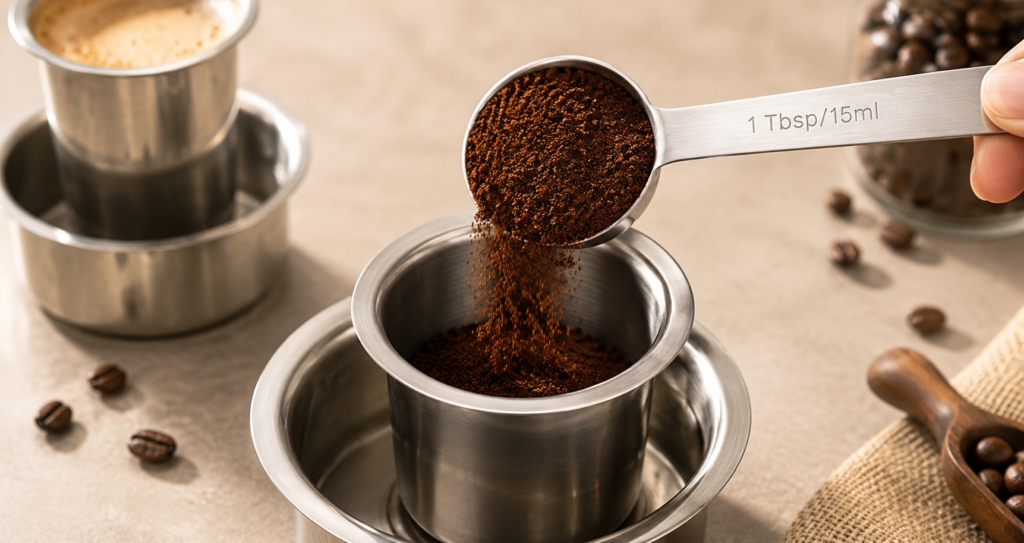
Coffee to water ratio is the missing piece behind a specific kind of inconsistency that shows up in almost every Indian kitchen that makes coffee at home. One day it’s strong enough to wake the dead. The next day, made by the same person, in the same steel tumbler, it tastes like slightly brown water. Nobody changed the brand. Nobody changed the beans. What changed is that the coffee powder went in by “feel” instead of by measurement, and feel is a terrible unit of measurement before 7 am.
This is the part nobody tells you when they hand down a filter coffee recipe: the difference between a good cup and a forgettable one is rarely the brand of coffee powder. It’s the ratio. Once you know the ratio and actually measure it, consistently, every single cup tastes like the best one you’ve ever made.
Why “Andaza” Doesn’t Work for Coffee
Every household has that one person who claims they can eyeball the coffee powder perfectly. Maybe they can, on a good day, with a steady hand and no distractions. But hand that same job to anyone else in the house — a spouse, a teenager, a houseguest — and the ratio falls apart immediately. A heaped spoon looks the same as a slightly-less-heaped spoon until you taste the result.
Professional baristas don’t eyeball anything. They weigh or measure every single time, because consistency is the entire job. You don’t need a barista setup at home, but you do need one thing: a spoon that measures the same amount every time you use it. That’s really the whole secret. Once the tool is consistent, the ratio does the rest of the work for you.
Coffee to Water Ratio: The South Indian Filter Coffee Formula That Actually Works
Traditional filter coffee, the kind made in a steel davara-tumbler with a filter decoction, generally works best with a stronger ratio than most people assume — somewhere close to 1 part coffee powder to 4 parts water for the decoction itself, before you mix it with milk.
In practical terms with a measuring spoon: 2 tablespoons of filter coffee powder (30ml) per 100ml of hot water in the upper chamber of the filter gives you a decoction strong enough to survive being diluted with hot milk later without turning weak and pale. This is where most people go wrong — they use decoction-strength measurements for the powder but then flood it with too much water, and the coffee percolates too fast to extract properly.
The fix is simple. Use a tablespoon measure for the powder, not a random spoon from the drawer, and let the water sit in the upper chamber rather than pouring it all in one go. Slow drip, consistent measure, same result every morning.
Instant Coffee: Grams Matter More Than You Think
Instant coffee gets treated casually because it dissolves instantly, so people assume precision doesn’t matter. It actually matters just as much, because instant coffee is far more concentrated than filter coffee powder gram for gram.
For a standard 150ml cup, 1 teaspoon (5ml) of instant coffee granules is the baseline for a regular-strength cup. If you’re making the frothy, whipped version that’s become popular across Indian homes — beaten with sugar and a few drops of water until it turns pale and fluffy before being added to hot or cold milk — the ratio is typically equal parts instant coffee, sugar, and water, usually 2 tablespoons of each, whipped for several minutes.
The mistake most people make here is measuring the coffee with the same spoon they use for sugar, without checking that both spoons are actually the same size. A mismatched spoon set throws off the whole batch, and the whipped coffee either refuses to turn fluffy or turns bitter enough to make your face fold.
Cold Brew: A Different Ratio Entirely
Cold brew has been showing up on more menus and more kitchen counters across Indian cities over the last couple of years, and it runs on a completely different ratio than hot coffee because there’s no heat to speed up extraction. Cold brew needs time instead of temperature, and a much higher coffee concentration to compensate.
A reliable starting ratio is 1 part coarsely ground coffee to 4 parts room-temperature or cold water, steeped in the refrigerator for 12 to 18 hours, then strained. In spoon measurements, that works out to roughly 8 tablespoons (120ml) of coarse coffee grounds to 500ml of water for a concentrate you can dilute with milk or water later to taste.
Because cold brew is meant to be diluted before drinking, most first-timers make it too weak by measuring for drinking strength instead of concentrate strength. Measure for concentrate, dilute at the end, and adjust from there.
The One Habit That Fixes All Three
Whether it’s filter coffee, instant, or cold brew, the underlying fix is identical: stop measuring by eye and start measuring with a proper spoon set that has consistent, marked sizes. A stainless steel measuring spoon set with clearly stamped tablespoon and teaspoon markings takes the guesswork out completely, and because it’s steel rather than plastic, it doesn’t hold onto coffee odour or stain over time the way plastic scoops eventually do.
Once the ratio becomes a habit rather than a guess, coffee stops being something you get right by accident on a good day and starts being something you get right every single day, on purpose.
faq
For a strong South Indian-style decoction, use about 2 tablespoons (30ml) of filter coffee powder per 100ml of hot water, then dilute with hot milk to taste.
For a regular 150ml cup, 1 teaspoon (5ml) is the standard baseline. Increase to 1.5 teaspoons if you prefer a stronger cup.
A safe starting ratio is 1 part coarse coffee grounds to 4 parts cold water, steeped for 12–18 hours, then diluted before drinking.
In most cases it’s inconsistent measuring, not the coffee itself. Switching to a fixed measuring spoon instead of an approximate scoop usually solves it within a few tries.