
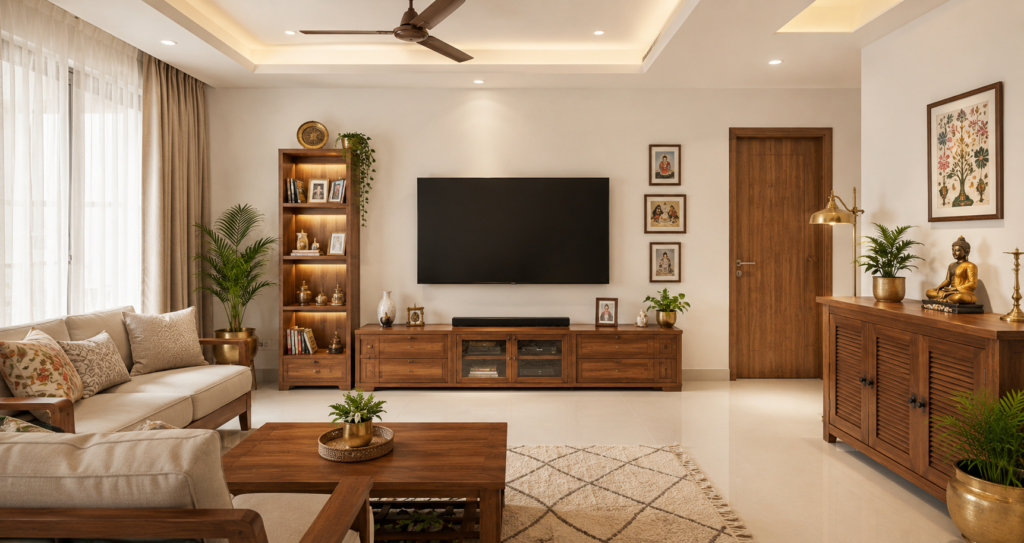
Homepixi Remote Control Holder exists precisely because of scenes like this: walk into most Indian living rooms and you’ll find the same honest chaos. The remote control is somewhere in the sofa cushions — or possibly on the dining table, or balanced on the arm of a chair. The charging cables have formed a small colony behind the television unit. There’s a stack of newspapers from last week sitting on the coffee table next to a water bottle, a pair of reading glasses, and something that was placed there “just for now” three weeks ago.
This is not a design failure. It’s what happens when a living room is genuinely lived in by real people with real lives — people who eat dinner in front of the TV, charge three devices simultaneously, have children who treat the sofa as a launching pad, and entertain guests on weekends without much notice.
The good news is that none of this requires renovation to fix. No new shelving units built into the wall. No expensive interior designer. No gutting the room and starting again. What it requires is a smarter approach to the space you already have — and a few well-chosen tools and products that do the organising work quietly in the background.
This guide is for Indian homes specifically — the 2BHK and 3BHK apartments, the independent houses with living rooms that double as study spaces, the homes where the living room is also where the children do homework and where guests are received and where the whole family winds down at the end of the day. The solutions here are practical, affordable, and require nothing more than a free afternoon and the willingness to rethink what goes where.
Start With a Clear-Out, Not a Shopping Trip
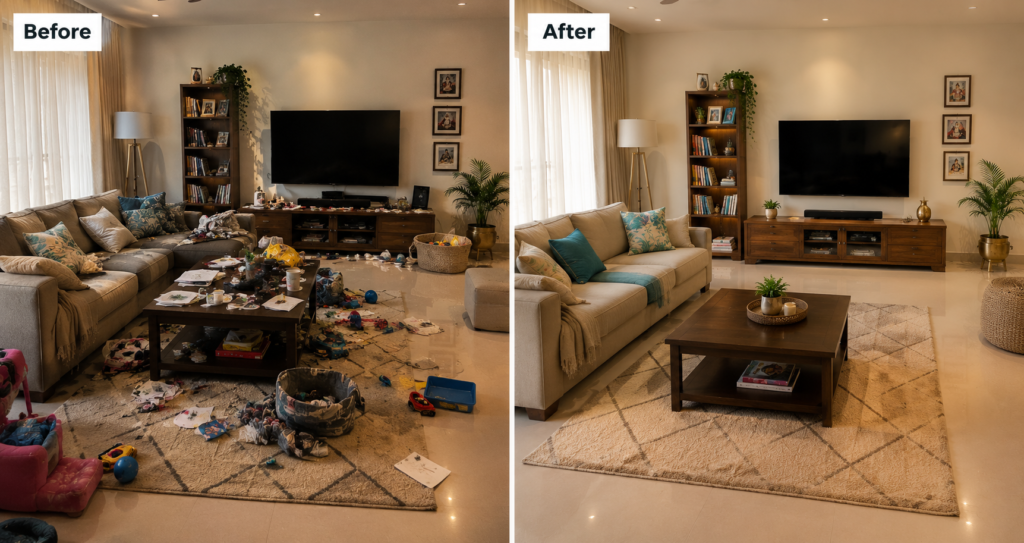
The single most effective thing you can do for your living room costs nothing and takes about two hours. Go through every surface — the coffee table, the TV unit, the side tables, the windowsills, the tops of cabinets — and remove everything that doesn’t belong there permanently.
This means the medicines that somehow ended up on the TV shelf. The bills and school circulars piled on the table. The toys that migrated from the children’s room. The shoes that got removed at the door but ended up three steps inside the room. The empty water bottles, the spare keys, the chargers that aren’t connected to anything.
Separate everything into three categories: things that belong in another room, things that belong in this room but need a proper home, and things that can be discarded or donated. Do the discarding first — it’s always easier to organise a smaller quantity of things than a larger one.
Only once the clear-out is done does it make sense to think about organisation tools and storage products. Buying organisers for a cluttered room without first reducing the clutter is one of the most common home organisation mistakes people make. You end up with neatly organised clutter instead of less clutter.
The clear-out is the renovation. Everything after this is maintenance.
Fix the Remote Control Problem Once and For All
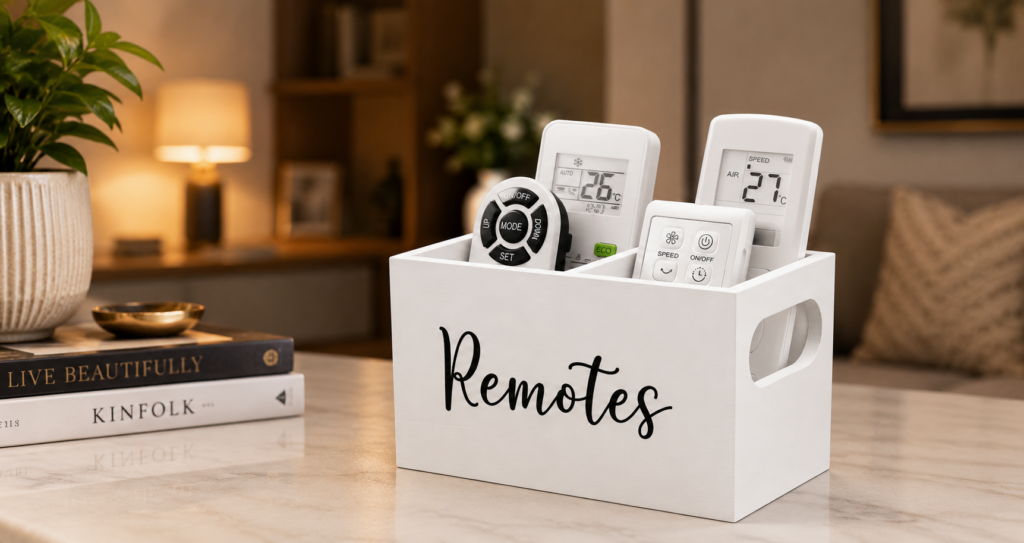
In most Indian households, a single living room contains at least three remote controls — one for the television, one for the set-top box or OTT device, and one for the air conditioner or ceiling fan. Add a fourth for a sound bar or home theatre system and you have a small collection of devices that spend most of their lives lost between sofa cushions or camouflaged on the dining table.
The cost of this small daily chaos is surprisingly high — not in money, but in time and frustration. Studies on domestic friction consistently find that searching for misplaced items is one of the most common sources of minor daily stress in households. The remote control is a small symbol of a larger problem: things in the living room don’t have a fixed home, so they end up everywhere.
The fix is as simple as it sounds: give the remotes a permanent, visible home and train everyone in the household to return them there after use.
A dedicated remote control holder — placed on the coffee table, the TV unit, or the side table nearest to the sofa — solves this immediately. It works because it creates a physical cue. When the remote has a holder, everyone can see at a glance whether it’s there or missing. The visual prompt is enough to create the habit of returning it.
The Homepixi wooden remote control holder is designed for exactly this — compact enough to sit on a coffee table without taking up space, with compartments that hold multiple remotes upright and visible. The wooden finish also means it doesn’t look like a storage solution — it looks like a considered piece on the table, which matters in a living room that guests will see.
Beyond remotes, the same holder works for other small items that tend to migrate and get lost — reading glasses, a pen, a small notepad for jotting down grocery lists or phone numbers during a call. One holder, multiple problems solved.
Manage the Cable Chaos Behind Your TV Unit
The area behind and around the television unit is where living room organisation goes to die in most Indian homes. Power strips with four or five plugs. HDMI cables. Ethernet cables. Charging cables for phones and tablets. The set-top box cable. The antenna wire. All of it tangled together into a mass that nobody wants to deal with and everybody tries not to look at.
This is partly a cable problem and partly a positioning problem. Most TV units are placed against walls with a single power outlet, which forces everything into one dense cluster. The fix doesn’t require rewiring the room.
Bundle and label cables. Use velcro cable ties (reusable and damage-free) to bundle cables that run in the same direction. Label each cable at both ends with small tags — this sounds excessive until the first time you need to disconnect one specific cable and can identify it immediately without unplugging everything.
Use a power strip with a cover or enclosure. Several affordable power strip covers are available online that enclose the strip and its plugs inside a box, leaving only the cables emerging from a slot. The visual effect of going from an exposed tangle to a closed box is immediate and significant.
Route cables along the back edge of the TV unit rather than across the floor. Adhesive cable clips (available at any hardware store for a few rupees each) allow you to run cables along the back or underside of furniture and keep them off the floor entirely. Cables on the floor get kicked, tripped over, and collect dust. Cables routed along furniture edges disappear visually.
Reduce the number of devices. This is the uncomfortable truth behind most TV unit cable tangles: there are simply too many devices. A streaming stick often replaces a set-top box. A soundbar with Bluetooth eliminates the need for multiple cables. Every device you can remove from the equation removes its cable from the tangle permanently.
Create Dedicated Zones Within the Room
One of the most effective concepts in home organisation is zoning — dividing a room into areas where specific activities happen, and keeping everything related to that activity contained within that area. Most interior designers apply this to large open-plan spaces, but it works just as well in a standard Indian apartment living room.
Think about what actually happens in your living room on a typical day. There’s a viewing area around the TV. There might be a spot where one family member reads or works on a laptop. There’s likely an informal charging station where phones go at the end of the day. If you have children, there’s probably an area that functions as a casual play space even if it was never intended as one.
Each of these is a zone. The organisation strategy is to define each zone clearly and ensure that everything belonging to that zone stays within it.
The viewing zone — sofa, TV unit, remote control holder. Nothing else belongs here permanently. Books, newspapers, and devices should have homes in other zones.
The reading or work zone — if someone regularly reads or works in the living room, give them a specific chair or corner with a side table, a lamp, and a small organiser for their books, laptop charger, and stationery. When everything for that activity lives in one spot, it stops migrating across the rest of the room.
The charging zone — pick one spot and make it the household charging station. A small tray or organiser on a side table or shelf, with a single power strip behind it, becomes the place where all devices go to charge. This eliminates the cables draped over sofa arms and phones left on the dining table or the floor.
The children’s corner — if children use the living room, give them a defined space with a small storage basket or box for their things. Knowing where their stuff lives makes them more likely to put it back — and makes it easier for adults to enforce the habit.
Zones don’t require physical barriers or new furniture. They’re defined by what’s placed where and the habits built around those placements.
Make Your Surfaces Work Harder
The surfaces in a living room — the coffee table, the TV unit shelf, the top of a cabinet, the windowsill — have two possible states. They’re either organised intentionally or they become landing pads for whatever anyone is holding when they walk through the room. In most homes, they’re landing pads.
The simplest way to convert a surface from a landing pad to an intentional space is to fill it deliberately before clutter can. A surface that has a tray, a small plant, and two books on it sends a clear visual message — this is styled, there is no room for random objects here. A completely empty surface sends the opposite message.
Use trays to define surface boundaries. A tray on a coffee table contains the items on it and makes the whole arrangement look intentional. Remote controls inside a holder on a tray, a small candle, a coaster — this reads as décor rather than clutter. The tray also makes the whole surface easy to move when cleaning — lift the tray, wipe the table, replace.
The rule of three for shelves. On any open shelf in the living room, limit decorative items to three per section. More than three items on a shelf starts to look crowded regardless of how nice each individual item is. Odd numbers — one, three, or five items — create more visual balance than even numbers.
Keep one surface completely clear. Every living room benefits from having one surface — usually the main coffee table — that’s kept completely clear except for a tray arrangement. This gives the eye a place to rest and makes the room feel more spacious than it is.
Add Organisation Through Décor, Not Storage Boxes
The best organisation solutions in a living room are the ones that don’t look like organisation solutions. Nobody wants their home to look like a storage facility. The goal is a room that feels calm and considered — where things have a place and where that place looks good.
This is where décor and organisation overlap.
A basket is also a storage solution. A large wicker or fabric basket on the floor beside the sofa — something that looks like it belongs there as a décor element — can hold blankets, cushion covers, children’s toys, or anything else that needs to live in the living room but not be visible. It reads as styling. It functions as storage.
A trinket tray on the side table keeps small items — keys, coins, a watch, earrings removed before sitting down — contained and intentional rather than scattered. A small decorative tray costs very little and eliminates an entire category of surface clutter.
Wall-mounted décor reduces surface clutter. Anything that goes on the wall is something that doesn’t need to occupy a surface or a shelf. A wall clock, a framed print, a small hanging planter — each of these adds character to the room while keeping surfaces free. In Indian homes where space is often at a premium, thinking vertically is always worth the effort.
Plants do double duty. A small indoor plant on a shelf or side table fills visual space in a way that prevents random objects from accumulating there. It’s difficult to casually dump things on a surface that already has a plant taking up the right amount of space.
Build Habits, Not Just Systems
The most beautifully organised living room in the world stays organised for approximately four days if the habits that maintain it aren’t in place. Organisation is not a one-time event — it’s a daily practice that becomes easier as it becomes automatic.
Two habits make the biggest difference in a living room:
The ten-minute reset. Each evening — before dinner, before bed, or at whatever moment works for the household — spend ten minutes returning the living room to its baseline. Remotes in the holder. Devices on charge. Papers filed or moved to where they belong. Blankets folded. Cushions back on the sofa. Ten minutes daily prevents the accumulation that eventually requires a half-day clear-out.
The one-in-one-out rule for surfaces. Every time something new is placed on a living room surface permanently, something else must leave. This keeps the number of items in the room stable rather than growing gradually until every surface is covered.
These habits work best when the organisation system underneath them is simple enough to be maintained without effort. A remote control holder works because putting the remote back takes one second. A basket works because dropping things in requires no precision. The simpler the system, the more consistently it gets used.
FAQ
Focus on vertical space — use wall shelves and wall-mounted décor to free up floor and surface area. Define clear zones for different activities, keep surfaces styled intentionally to prevent clutter accumulation, and invest in multi-purpose furniture like ottomans with storage or coffee tables with shelves underneath.
A dedicated remote control holder placed in a consistent, visible location on the coffee table or TV unit is the most effective solution. The physical presence of the holder creates a visual habit cue — everyone in the household can see immediately whether remotes are in place or missing.
Keep the floor as clear as possible, use light colours on soft furnishings, ensure adequate lighting especially in corners, and remove unnecessary furniture. Organised, clutter-free rooms consistently look larger than cluttered ones of identical dimensions.
A thorough clear-out every three months works well for most households. Daily ten-minute resets prevent clutter from building to the point where a major clear-out feels overwhelming.
The living room should contain seating, entertainment equipment, and items used daily in that space — remotes, chargers, a book currently being read. Everything else — medicines, school bags, tools, items from other rooms — should be returned to their proper locations as part of the daily reset habit.