
Every household with a slipping rug eventually reaches for the same drawer item: double-sided tape. It’s already in the house, it’s cheap, and it feels like it should work. Two strips under the corners, press down, done.
Then, within a week or two, the corner lifts anyway. Or worse, it holds perfectly — right up until you try to remove it, and half the tape stays fused to your marble while the other half stays fused to the rug backing, with a thin grey residue line marking exactly where it used to be.
This is the point where most people start looking for something built specifically for the job, and that’s where rug grippers come in. But it’s worth actually comparing the two properly rather than just taking that as a given, because on some floors the difference is bigger than others.
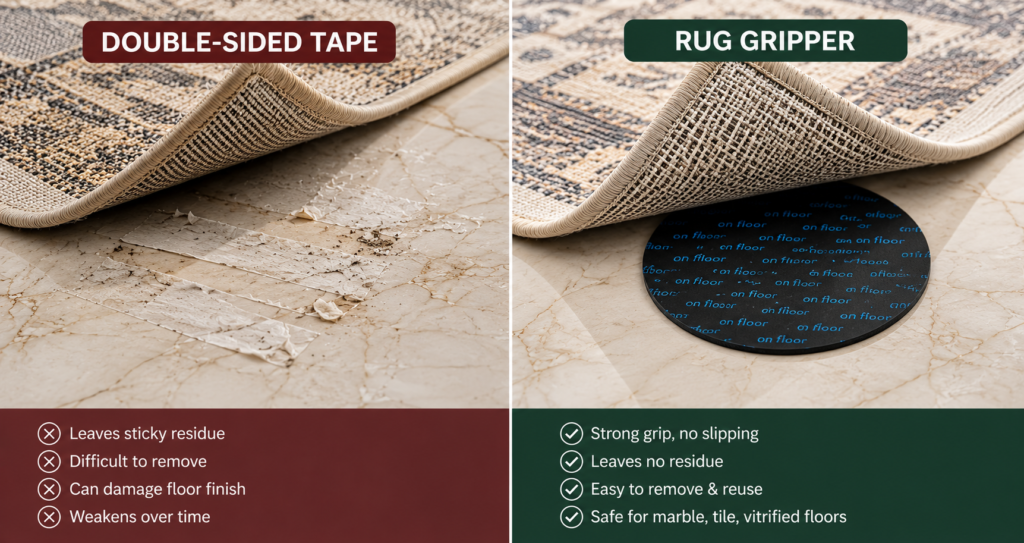
The Core Difference: How Each One Actually Grips
To understand why one outperforms the other on Indian floors specifically, it helps to know what each product is actually engineered to do.
Double-sided tape — the kind sitting in most Indian homes — is almost always general-purpose stationery or packing tape, or at best a basic mounting tape meant for lightweight wall hangings. Its adhesive is formulated for a single, mostly static bond: stick two flat surfaces together and leave them alone. It is not engineered for repeated shear stress, which is the sideways, dragging force a rug undergoes every time someone walks across it, drags a chair over it, or a broom sweeps past.
Rug grippers, by contrast, are purpose-built for exactly that shear stress. The adhesive formulation is designed to flex slightly under sideways pressure while still holding its bond, and the application method — multiple small discs or strips at corners and edge midpoints — spreads the load across several independent anchor points instead of one long unbroken strip. If one point weakens slightly, the rug doesn’t shift, because the other anchor points are still holding.
That structural difference is the entire story here. It’s not that gripper adhesive is simply “stronger” — it’s built for a different kind of stress altogether.
Round 1: Grip Strength on Marble
Marble is the toughest test case, since it’s polished specifically to be smooth and reflective, which means minimal microscopic texture for anything to grip onto.
Double-sided tape typically bonds well on marble for the first 2–4 days. After that, foot traffic and the natural flex of the rug material start working the tape loose at the edges, and once one edge lifts even slightly, dust gets underneath and adhesion drops fast from there.
Rug grippers hold considerably longer under the same conditions — commonly several weeks to a few months before needing a refresh — because the adhesive is designed for exactly this smooth, non-porous surface type, and the multi-point anchoring means localized wear doesn’t cascade into full rug movement.
Winner: Rug gripper, by a clear margin on marble specifically.
Round 2: Vitrified Tile and Granite
Vitrified tile behaves similarly to marble in this comparison — glassy, low-friction, minimal texture. Granite has slightly more micro-texture depending on the finish (polished vs leathered), which helps both products marginally, but the underlying pattern holds.
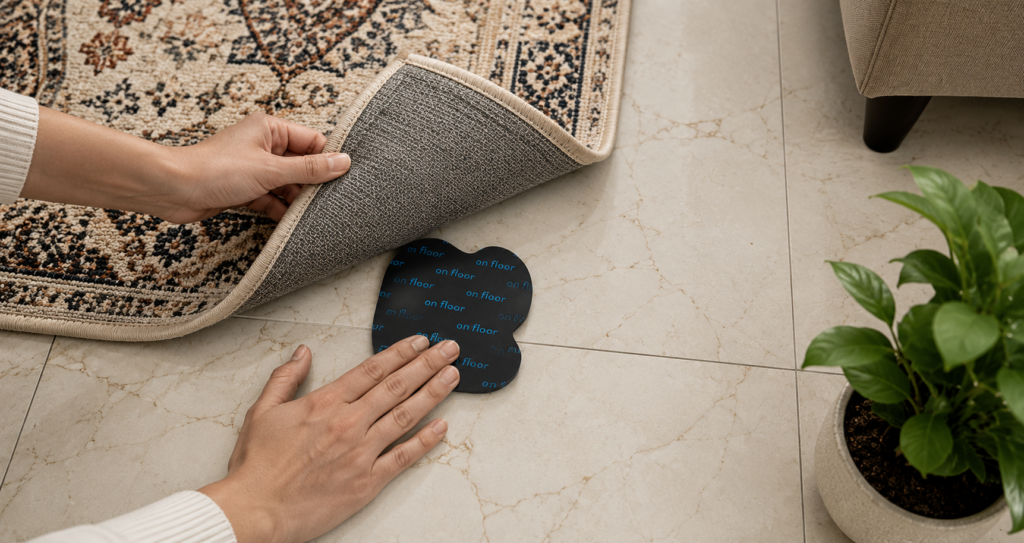
Tape tends to fail faster on tile than on marble in humid months specifically, because tile floors in ground-floor or coastal Indian homes often carry a fine, near-invisible layer of moisture that most people don’t even register as damp. That moisture is enough to undermine a tape bond meaningfully, while gripper adhesives formulated for indoor floor use tend to tolerate this better.
Winner: Rug gripper, with the gap widening further during monsoon months.
Round 3: Residue and Cleanup
This is where the comparison stops being close at all.
Double-sided tape, once removed, very often leaves behind an adhesive residue line on polished marble or tile. Getting that off cleanly usually requires a solvent — sometimes something as strong as isopropyl alcohol or a dedicated adhesive remover — and repeated scrubbing on a polished surface risks dulling the shine, especially on marble, which scratches and etches more easily than people expect.
Quality rug grippers are formulated to release cleanly. Peel the gripper off, and in the vast majority of cases the floor underneath is untouched — no film, no cloudy patch, nothing that needs a solvent to fix. This matters enormously if you’re periodically rearranging furniture or rotating rugs between rooms, which most Indian households do more often than they’d admit.
Winner: Rug gripper, decisively.
Round 4: Rented Flats and Security Deposits
If you’re renting, this round matters more than any of the others.
Tape residue on a marble or tile floor is exactly the kind of thing a landlord will flag during a move-out inspection, and cleaning it off yourself with a strong solvent carries its own risk of leaving an etched or dulled patch that’s arguably worse than the residue itself.
A rug gripper designed for clean release avoids this problem almost entirely, which makes it the safer default if you don’t own the floor you’re sticking it to. We’ve covered similar landlord-safe thinking in our guide to decorating a rented flat without damaging walls — the same logic that applies to walls applies to floors here.
Winner: Rug gripper, especially for renters.
Round 5: Cost
This is the one round where tape genuinely wins, and it’s worth being honest about it.
A roll of basic double-sided tape is usually cheaper upfront than a pack of dedicated rug grippers, and if you’re testing a fix on a rug you’re not attached to, or solving a one-off, temporary problem, tape’s low cost is a real point in its favour.
But cost-per-use tells a different story. Because tape needs replacing every 1–2 weeks under regular foot traffic, and each replacement risks residue that then needs cleaning, the “cheaper” option often ends up costing more time and floor-care effort over a few months than a single gripper pack that lasts through the same period without intervention.
So When Does Tape Actually Make Sense?
To be fair to tape, there are a couple of scenarios where it’s a reasonable short-term call:
- A one-time event — a puja, a get-together, a photoshoot — where the rug only needs to stay put for a few hours
- A very lightweight mat on a low-traffic spot, like a decorative accent rug that rarely gets walked on
- A genuine emergency fix when nothing else is on hand and the floor isn’t polished stone
Outside of these situations, especially for anything on marble, tile, or vitrified flooring that sees daily foot traffic — the entrance doormat, a kitchen rug, a living room centre rug — tape is a short-term patch, not a real fix.
The Bottom Line
For Indian homes specifically, where marble, tile, and vitrified flooring dominate and humidity swings hard between seasons, a purpose-built rug gripper outperforms double-sided tape on every metric that actually matters day to day: how long it holds, how it handles moisture, and — perhaps most importantly — how cleanly it comes off when you need to move the rug or move out of the flat altogether.
Tape wins on the shelf price. Grippers win everywhere your foot actually lands.
Homepixi’s Rug Gripper for Carpet is built specifically for marble, tile, and vitrified surfaces, with the clean-release adhesive this comparison keeps coming back to. If your rug’s already fighting you every morning, this is the one round worth settling for good.
Frequently Asked Questions
It can be used short-term, but repeated use often leaves adhesive residue that requires a solvent to remove, and aggressive scrubbing on polished marble risks dulling its shine over time. For daily-use rugs, a purpose-built rug gripper is the safer long-term choice.
On smooth surfaces like marble or vitrified tile with regular foot traffic, double-sided tape typically loses effective grip within one to two weeks and needs replacing, compared to several weeks to a few months for a quality rug gripper.
A well-formulated rug gripper is designed to release cleanly from both the floor and the rug backing, with minimal to no residue in most cases, unlike standard double-sided tape.
A rug gripper is generally the safer choice for rented flats, since it’s designed to release without leaving residue or requiring solvents that could damage flooring and affect a security deposit.