
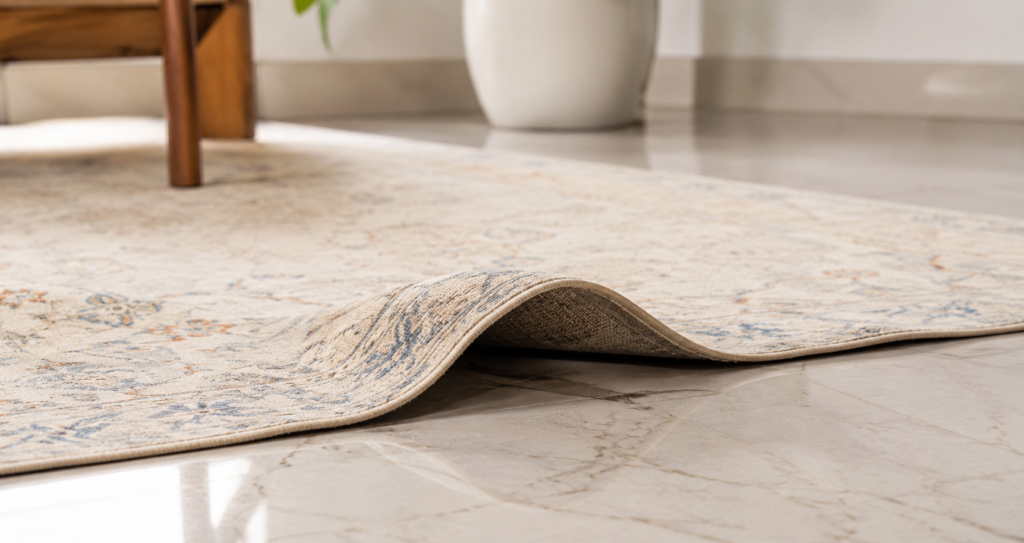
There’s a specific sound every Indian household knows. It’s not quite a slip, not quite a fall — just that half-second scramble when a rug shifts under your foot on the way to the kitchen at 6 AM, still half-asleep, chai on the mind. Somehow you catch yourself. Somehow the rug ends up bunched against the wall, and the doormat by the front door has walked itself two feet to the left again, for the third time this week.
If this sounds familiar, you’re not doing anything wrong. Indian homes have a flooring problem that most rugs simply weren’t designed for.
Why Rugs Slide So Much More in India Than in Western Homes
This isn’t in your head, and it isn’t a cheap-rug problem either. It comes down to what’s actually under the rug.
Most home design content around rugs and rug pads is written for countries where homes are carpeted wall-to-wall, or where hardwood and engineered wood floors are the norm. Wood has microscopic texture and a bit of give. A cotton or jute rug sitting on wood already has some natural grip working in its favour.
Indian homes are different. The dominant flooring types here are:
- Vitrified tiles — glassy smooth, almost zero surface friction
- Marble — polished to a shine specifically because a matte marble floor looks “unfinished” to most buyers
- Granite — common in kitchens and increasingly in living rooms, and just as slick
- Kota stone — a bit more porous, but still smoother than any wood surface
Add two more India-specific factors on top of that. First, humidity. Even in cities that aren’t coastal, indoor humidity swings hard between monsoon and summer, and that affects how rugs sit — jute and cotton rugs especially can curl or shift slightly as they absorb and release moisture. Second, most Indian homes don’t use the underlay or rug-pad culture that’s standard in the US or Europe. A rug pad there is almost assumed; here, it’s rarely even sold alongside the rug at the point of purchase.
Put a lightweight rug on a glass-smooth floor with no pad underneath, in a climate that keeps subtly shifting the fibres — and slipping isn’t a defect. It’s physics.
The Doormat Problem Is Its Own Beast
Doormats slide for a slightly different reason, and it’s worth separating the two because the fix differs.
A doormat sits right at the highest-traffic, highest-force point in the house — the front door. Every person walking in wipes their feet with some sideways pressure, often while carrying bags, holding an umbrella during monsoon, or juggling a child’s hand. That sideways force is exactly what pushes a mat out of place, especially on tile thresholds or the smooth transition strip between a corridor and the house.
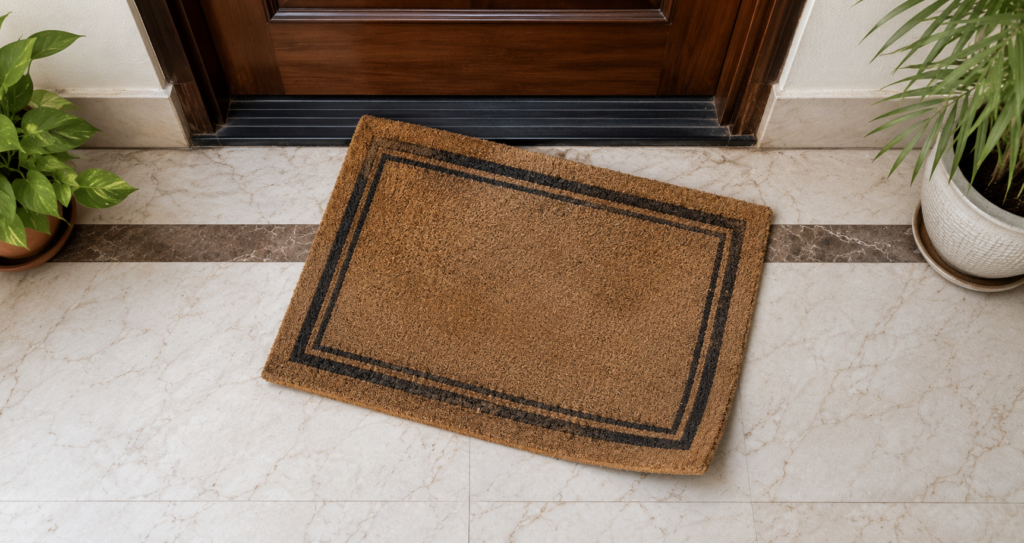
Outdoor-facing doormats have an extra complication too — monsoon runoff. Water gets underneath, the mat becomes even lighter in contact-friction terms (a wet smooth surface under a wet mat is worse, not better), and it slides more, not less.
Why Tape and DIY Fixes Don’t Actually Solve This
Almost everyone tries the same handful of workarounds before landing on a real solution, so it’s worth being honest about why they don’t hold up.
Double-sided tape. This is the most common fix, and it fails for a predictable reason: standard stationery or packing tape isn’t designed for repeated shear stress. It grips once, loses tack within a few days of foot traffic, and then leaves a sticky residue on both the rug backing and the floor — which on marble is genuinely difficult to clean off without a solvent that can dull the polish.
Furniture placed on the corners. Anchoring a rug under a sofa leg or coffee table only stabilises that one corner. The opposite end — the part you actually walk over — still slides freely.
Rubber shelf liner cut to size. Better than tape, but liner isn’t made for floor-to-floor friction. It’s designed to grip inside a drawer or cabinet, and it tends to migrate and bunch at the edges within a couple of weeks on an open floor.
“Non-slip backing” rugs. Some rugs are sold with a printed rubber-dot backing already on them. This helps on textured floors, but on truly glass-smooth marble or vitrified tile, even factory backing loses grip over time as the rubber compresses and the dots flatten.
None of these are bad ideas exactly — they’re just solving for the wrong kind of surface. Indian floors need a grip solution built specifically for smooth, non-porous surfaces, not a workaround borrowed from a different flooring culture.
The 2-Minute Fix: Anti-Slip Rug Gripper Stickers
This is the actual fix, and it earns the “2 minutes” claim because there’s genuinely nothing complicated about it.
A rug gripper works differently from tape. Instead of one continuous adhesive strip that has to hold the entire shear force of a rug at once, gripper stickers use small, strategically placed adhesive-backed discs or strips — typically applied at the corners and mid-edges of the rug. Each one anchors a small section independently, so the rug is held down at multiple points rather than relying on a single point of failure.
Here’s what applying one actually looks like:
- Clean the floor spot first. A quick wipe with a dry cloth removes dust that would otherwise weaken the bond. Skip this step and you’ll cut adhesion life roughly in half.
- Lift the rug corner and peel the backing off one gripper piece.
- Press it onto the floor, not the rug, and hold for about 10 seconds.
- Lay the rug back down over it and press firmly along that section.
- Repeat at each corner and, for larger rugs, at the midpoints of the longer edges.
That’s the whole process. For an average 4×6 ft living room rug, this takes under two minutes with four gripper points. A hallway runner might need six to eight points given its length, which still lands well under five minutes total.
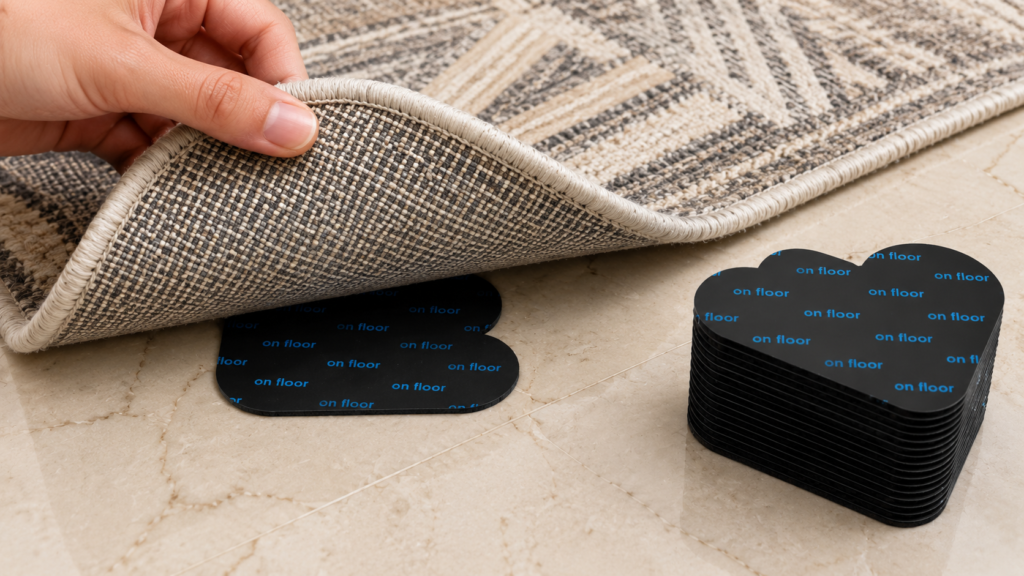
The reason this holds up on marble and tile specifically is the adhesive formulation. A good rug gripper uses a high-tack, low-residue adhesive designed to bond with polished, non-porous surfaces — the same category of surface that regular tape struggles with — while still releasing cleanly if you ever need to reposition the rug or move house.
Where This Matters Most in an Indian Home
A few spots see this problem more than others, and it’s worth being deliberate about where you use grippers first if you’re doing this room by room:
- The entrance doormat — highest traffic, highest shear force, first thing guests notice if it’s crooked
- Rugs in front of the kitchen sink or stove — this is a genuine safety issue, not just an aesthetic one, since this is exactly where someone is likely to be holding something hot
- Bathroom-adjacent mats — wet feet plus smooth tile is the single riskiest slip combination in most Indian homes
- Rugs under work-from-home desk chairs — the rolling and swivelling motion of an office chair shifts a rug far more aggressively than regular foot traffic
If you’ve read our monsoon home care guide, you’ll know monsoon months are exactly when floors get wettest and rugs move most — so this is a good time of year to sort this out before the humidity picks up further.
A Note for Rented Flats
If you’re in a rented flat and have been hesitant to commit to anything adhesive on the floor — a fair concern, and one we covered in detail in how to decorate a rented flat without damaging walls — a quality rug gripper is one of the few genuinely landlord-safe fixes available. Designed correctly, it releases cleanly without pulling up tile sealant or leaving a sticky mark behind, unlike mounting tape or adhesive hooks.
Final Thought
A slipping rug isn’t a sign you bought the wrong rug, and it isn’t something to just live with until you eventually stop noticing the risk. It’s a mismatch between the rug and the floor underneath it — and on Indian tile and marble, that mismatch is almost universal. The fix isn’t expensive, it isn’t time-consuming, and once it’s done, it’s done. No re-taping every fortnight, no residue to scrub off later.
Homepixi’s Rug Gripper for Carpet is built specifically for this — strong floor grip on tile, marble, and vitrified surfaces, with clean release when you need to move or reposition. Two minutes now saves a scramble later.
Frequently Asked Questions
No, when applied and removed correctly, a quality rug gripper won’t damage sealed marble, tile, or vitrified flooring. The adhesive is designed to bond firmly during use but release cleanly without pulling up sealant or leaving lasting residue.
Most rug gripper stickers hold their grip for several months of regular foot traffic. If a piece loses tack, a quick wipe of the floor and rug backing with a damp cloth followed by drying often restores adhesion, though heavily worn pieces are best replaced.
depends on the adhesive residue left behind after removal. In most cases, light residue can be cleaned off both surfaces and a fresh set of grippers applied, since the stickers are inexpensive enough that replacing them per move is the simpler option.
Yes, though the effect is even more noticeable on smooth surfaces like marble and vitrified tile, where rugs typically slip the most. On textured floors like some Kota stone finishes, grippers still add useful extra hold, particularly at high-traffic points like doorways.